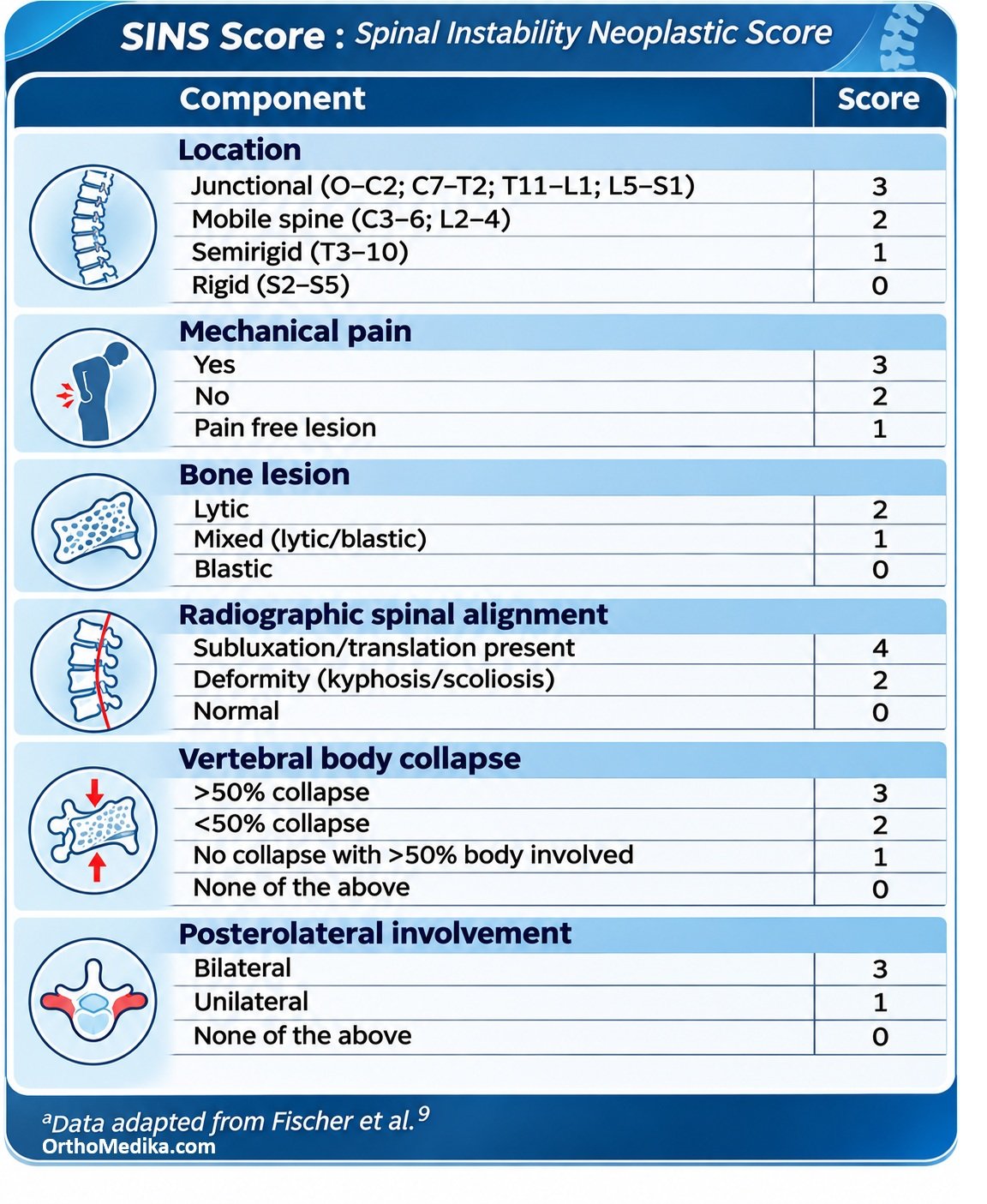
SINS (Spinal Instability Neoplastic Score) is a structured 0–18 point assessment for spinal instability caused by cancer metastases. It tells the care team whether a spinal tumor is likely stable, potentially unstable, or unstable, and whether a spine-surgeon consultation is needed.
Purpose
Cancer can weaken vertebrae, destroy bone, cause collapse, and make the spine unable to bear normal loads. SINS standardizes this assessment so oncologists, radiation oncologists, and spine surgeons can communicate consistently and choose between observation, radiotherapy, surgery, or combined treatment.
It is not a cancer-stage score and does not by itself predict survival. It mainly answers one question: how mechanically unstable is this particular spinal lesion?
The six components
SINS has one clinical component and five imaging components. Add the points from all six.
| Component | What it assesses | Points |
| 1. Location | Whether the tumor is in a high-stress, mobile, or rigid part of the spine | 0–3 |
| 2. Mechanical pain | Pain that changes with movement, standing, or spinal loading | 0–3 |
| 3. Lesion type | Whether the tumor destroys bone, forms bone, or does both | 0–2 |
| 4. Spinal alignment | Whether the spine has shifted or developed a new deformity | 0–4 |
| 5. Vertebral body collapse | How much the front part of the vertebra has collapsed | 0–3 |
| 6. Posterolateral involvement | Whether the posterior supporting structures are involved | 0–3 |
The maximum possible total is 18 points.
Location: 0–3 points
Some spinal regions experience more movement and mechanical stress than others.
| Location | Points | Why it matters |
| Junctional zones: occiput–C2, C7–T2, T11–L1, L5–S1 | 3 | Transition zones between mobile and rigid regions; high stress |
| Mobile segments: C3–C6, L2–L4 | 2 | Considerable movement |
| Semi-rigid thoracic spine: T3–T10 | 1 | Supported by the rib cage |
| Rigid sacrum: S2–S5 | 0 | Least mobile |
A tumor at T12, for example, is in the T11–L1 junctional zone and receives 3 points.
Mechanical pain: 0–3 points
This is the only part of SINS based on the patient’s symptoms rather than imaging.
| Pain pattern | Points |
| Pain worsens with movement, standing, or axial loading and improves when lying down | 3 |
| Occasional pain that is not clearly mechanical | 1 |
| No pain | 0 |
Mechanical pain is important because it suggests the spine may be losing its ability to support loads. This differs from constant tumor-related pain, which can occur even when the spine is structurally stable.
Lesion type: 0–2 points
This describes how the tumor affects bone on CT or X-ray.
| Lesion type | Points | Meaning |
| Lytic | 2 | Bone-destroying; weakest structure |
| Mixed lytic/blastic | 1 | Both destruction and new bone formation |
| Blastic | 0 | Bone-forming; usually relatively more rigid |
A purely lytic lesion contributes the most because it is more likely to weaken the vertebra.
Spinal alignment: 0–4 points
This is often the highest-weighted item because misalignment can indicate significant structural failure.
| Finding | Points |
| Vertebral translation or subluxation—one vertebra has slipped relative to another | 4 |
| New kyphosis or scoliosis—a new forward bend or sideways curvature | 2 |
| Normal alignment | 0 |
Translation/subluxation is particularly concerning because it can threaten the spinal cord and nerve roots.
Vertebral body collapse: 0–3 points
The vertebral body is the main weight-bearing portion of the vertebra.
| Finding | Points |
| More than 50% height loss | 3 |
| Less than 50% height loss | 2 |
| No collapse, but more than 50% of the vertebral body is involved by tumor | 1 |
| No collapse and less than 50% involvement | 0 |
More collapse means less remaining bone to carry load and a higher concern for further fracture.
Posterolateral involvement: 0–3 points
This evaluates the structures behind and beside the vertebral body, including the pedicles and facet joints.
| Finding | Points |
| Bilateral involvement | 3 |
| Unilateral involvement | 1 |
| No involvement | 0 |
These structures help stabilize the spine. When both sides are involved, the posterior column provides less support.
Interpreting the total
| Total SINS | Category | Typical action |
| 0–6 | Stable | Usually no referral specifically for instability; treat cancer and symptoms as appropriate |
| 7–12 | Potentially unstable / indeterminate | Spine-surgeon consultation is recommended |
| 13–18 | Unstable | Strong consideration of surgical evaluation and possible stabilization |
A score of 7 or above is the usual trigger for surgical consultation, but it does not automatically mean the patient needs an operation.
Worked example
Suppose a patient has a metastatic tumor at T12:
| Component | Finding | Points |
| Location | T12 is in the T11–L1 junctional zone | 3 |
| Mechanical pain | Pain with standing and walking, relieved lying down | 3 |
| Lesion type | Lytic lesion | 2 |
| Alignment | New kyphotic deformity | 2 |
| Collapse | Less than 50% vertebral-body height loss | 2 |
| Posterolateral involvement | Unilateral pedicle involvement | 1 |
| Total | 13 |
This patient’s SINS is 13, which is classified as unstable and warrants prompt spine-surgical assessment.
How SINS guides treatment
SINS is commonly used within a broader decision-making framework such as NOMS—Neurologic, Oncologic, Mechanical, Systemic. SINS addresses the “Mechanical” part; the team also considers neurologic deficit, tumor type and sensitivity to radiation/chemotherapy, extent of spinal-cord compression, prior treatment, and the patient’s fitness and life expectancy.
Typical implications:
- Low SINS (0–6): Radiotherapy, systemic cancer therapy, pain control, and monitoring may be sufficient.
- Intermediate SINS (7–12): Often needs multidisciplinary review; radiotherapy may still be appropriate, but surgical consultation helps determine whether fixation is prudent before or after treatment.
- High SINS (13–18): Surgery may be considered to decompress neural structures and stabilize the spine, particularly if there is mechanical pain, deformity, collapse, or neurologic risk.

 is a structured 0–18 point assessment for spinal instability caused by cancer metastases.)