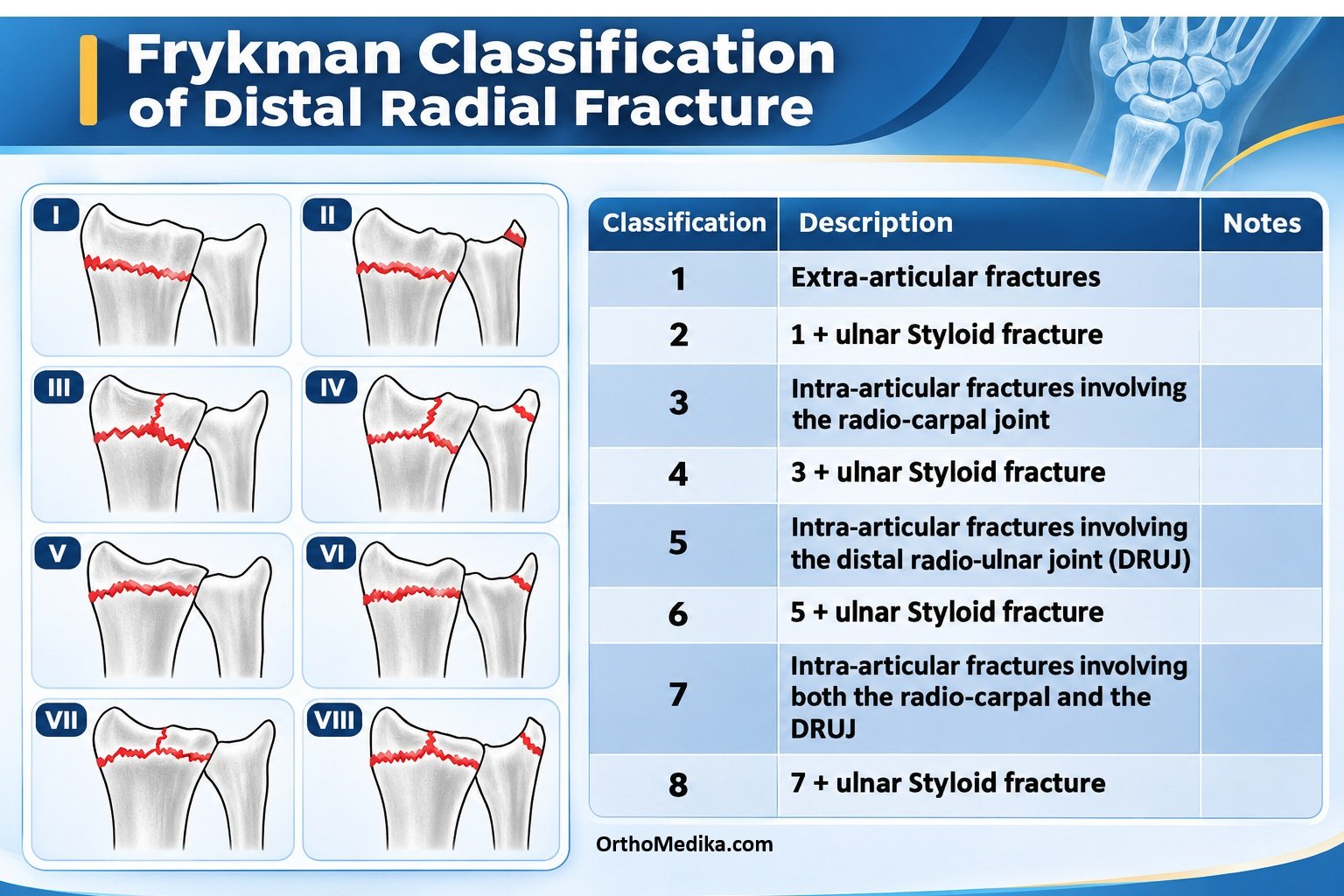
The Frykman classification is an academic system for describing distal radius fractures—fractures of the radius (thumb-side forearm bone) near the wrist. It is useful because it tells the clinician whether the fracture involves one or both wrist joints and whether the ulnar styloid is fractured, but it is not sufficient by itself to choose treatment.
Anatomy you need first
The distal radius is the wide, lower end of the radius, just above the wrist. It forms the main joint surface for the carpal bones and also articulates with the ulna.
Two joints are central to Frykman:
- Radiocarpal joint: the joint between the radius and the wrist bones, especially the scaphoid and lunate. A fracture entering this joint is called intra-articular.
- Distal radioulnar joint (DRUJ): the joint between the distal radius and distal ulna. It allows the forearm to rotate—palm up (supination) and palm down (pronation). A fracture entering this joint may affect rotation and stability.
The ulnar styloid is a small projection at the ulnar side of the wrist. It is attached to soft tissues including parts of the triangular fibrocartilage complex (TFCC), which helps stabilize the DRUJ.
The logic of Frykman
Frykman uses three questions:
- Does the fracture enter the radiocarpal joint?
- Does it enter the DRUJ?
- Is there an associated ulnar styloid fracture?
The first two questions create four basic patterns, numbered I, III, V, and VII. Adding an ulnar styloid fracture converts each odd type into the following even type: II, IV, VI, and VIII.
| Frykman type | Radiocarpal joint involvement | DRUJ involvement | Ulnar styloid fracture |
| I | No | No | No |
| II | No | No | Yes |
| III | Yes | No | No |
| IV | Yes | No | Yes |
| V | No | Yes | No |
| VI | No | Yes | Yes |
| VII | Yes | Yes | No |
| VIII | Yes | Yes | Yes |
Thus, Type VIII is the most extensive pattern: the fracture involves both joints and includes an ulnar styloid fracture.
Meaning of each group
Types I–II: extra-articular
The fracture is outside both joint surfaces. These are often simpler injuries, although they can still be displaced and unstable. Classic Colles fractures—dorsally tilted/angulated distal radius fractures after a fall on an outstretched hand—and Smith fractures—volarly tilted fractures—can fall into this group if they do not enter a joint.
- Type I: extra-articular radius fracture only.
- Type II: the same fracture plus an ulnar styloid fracture.
Types III–IV: radiocarpal joint involvement
The fracture line enters the wrist joint. This matters because displaced fragments can make the joint surface uneven, potentially leading to pain, stiffness, and post-traumatic arthritis.
- Type III: intra-articular fracture of the radiocarpal joint, no ulnar styloid fracture.
- Type IV: radiocarpal intra-articular fracture plus ulnar styloid fracture.
Examples include some Barton fractures (a shear fracture of the dorsal or volar rim of the radius) and chauffeur fractures (radial styloid fractures), depending on the exact fracture pattern.
Types V–VI: DRUJ involvement
The fracture enters the joint between radius and ulna. This can be clinically important because the DRUJ supports forearm rotation; associated injury may produce ulnar-sided wrist pain, reduced rotation, or instability.
- Type V: DRUJ intra-articular fracture, no ulnar styloid fracture.
- Type VI: DRUJ intra-articular fracture plus ulnar styloid fracture.
Types VII–VIII: both joints involved
These fractures enter both the radiocarpal joint and the DRUJ. They are generally considered more complex because both wrist motion and forearm rotation may be affected.
- Type VII: both joints involved, no ulnar styloid fracture.
- Type VIII: both joints involved plus an ulnar styloid fracture.
How severity is interpreted
In general, the classification moves from less to more complex:
- I–II: outside the joints.
- III–IV: wrist joint involved.
- V–VI: DRUJ involved.
- VII–VIII: both joints involved.
The presence of an ulnar styloid fracture does not automatically make a fracture unstable, but it raises concern for TFCC or DRUJ injury, especially if there is widening of the DRUJ or ulnar-sided pain


 near the wrist.)