 describes the shape and bone quality of the proximal femur on preoperative radiographs.)
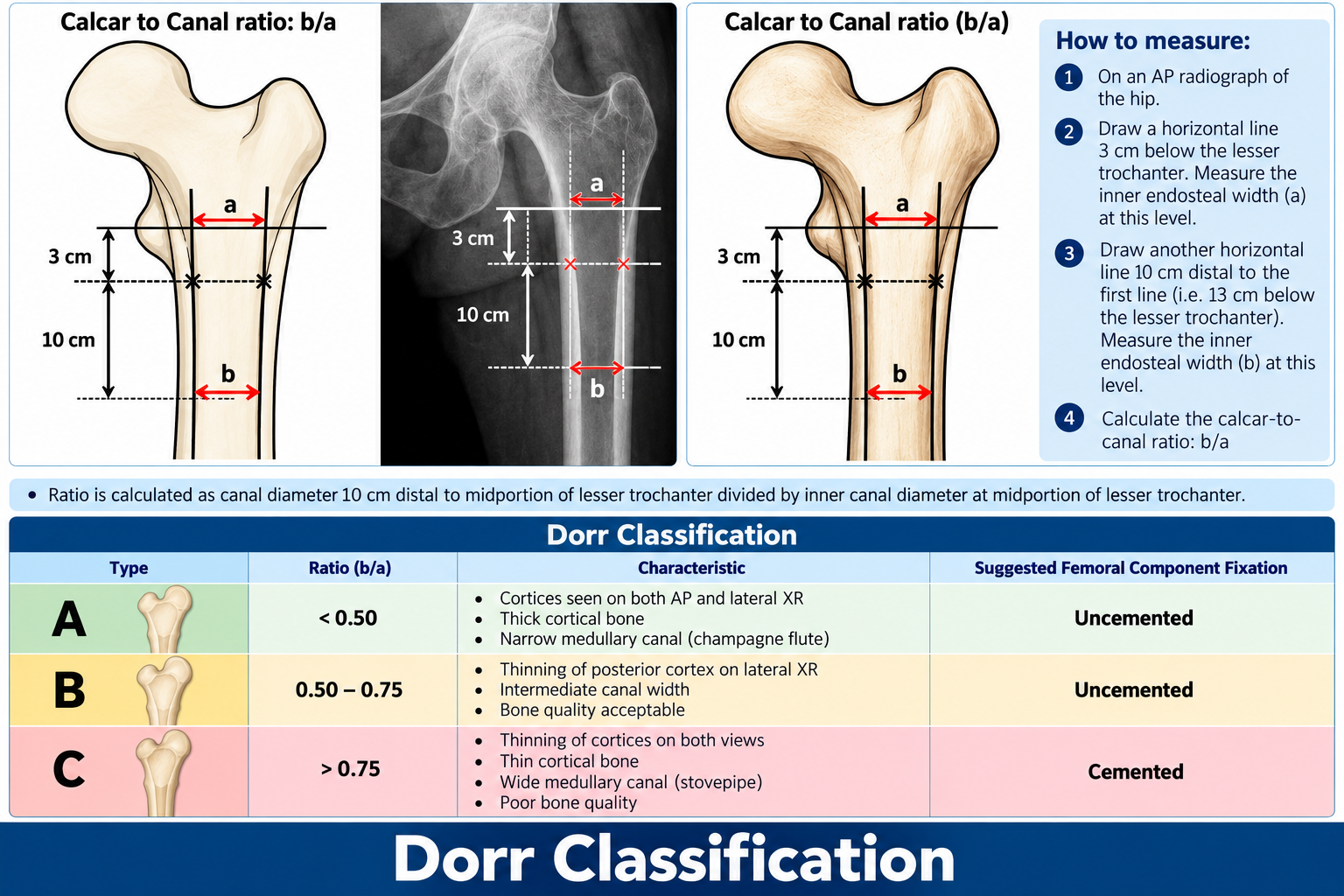
The Dorr classification for total hip replacement (THA) describes the shape and bone quality of the proximal femur on preoperative radiographs. It helps surgeons anticipate femoral preparation, risk of intraoperative fracture, and whether a cemented or uncemented femoral stem is more suitable
The three Dorr types
| Dorr type | Appearance | Canal flare index (CFI) | Canal-calcar ratio (CCR) | Typical stem implication |
| A — “champagne flute” | Thick cortices, narrow diaphyseal canal, strong proximal flare; posterior cortical “fin” is prominent | >4.7 | <0.50 | Often suits a tapered, proximally coated uncemented stem; good proximal bone support. pmc.ncbi.nlm.nih+1 |
| B — “normal” / intermediate | Moderate cortical thickness and canal flare; intermediate bone quality | 3.0–4.7 | 0.50–0.75 | Most stem designs can work; implant choice depends on bone quality, anatomy, and surgeon preference. pmc.ncbi.nlm.nih+1 |
| C — “stovepipe” | Thin, poorly defined cortices; wide, straight canal; loss of medial/posterior cortical definition | <3.0 | >0.75 | Often favors a cemented stem because proximal bone quality and rotational stability may be poor. pmc.ncbi.nlm.nih+2 |
Radiographic criteria
Dorr type is usually assessed on an AP hip/pelvis radiograph, ideally with a lateral view to inspect the posterior cortex. The key measurement is the ratio of canal width at the isthmus (about 10 cm below the lesser trochanter) to canal width at the level of the lesser trochanter.
- CCR < 0.50 → Dorr A
- CCR 0.50–0.75 → Dorr B
- CCR > 0.75 → Dorr Cnature+1
An alternative measure, the canal flare index (CFI), compares the intracortical width 20 mm above the lesser trochanter with the isthmus width:
- CFI > 4.7 → Dorr A
- CFI 3.0–4.7 → Dorr B
- CFI < 3.0 → Dorr C
Why it matters in THA
- Dorr A: Strong proximal bone and a narrow canal can provide good press-fit fixation, but broaching must be controlled to avoid fracture.
- Dorr B: The most common intermediate morphology; both cemented and cementless fixation are commonly feasible.
- Dorr C: Thin cortices, osteopenia, and a wide “stovepipe” canal reduce the reliability of cementless proximal fixation; cemented fixation is often considered.
REFERENCES:
Wilkerson J, Fernando ND. Classifications in Brief: The Dorr Classification of Femoral Bone. Clin Orthop Relat Res. 2020 Aug;478(8):1939-1944. doi: 10.1097/CORR.0000000000001295. Epub 2020 May 6. PMID: 32732579; PMCID: PMC7371079.
Gong, Y., Huang, H., Su, H. et al. How does the Dorr classification of proximal femur affect the total hip arthroplasty of hemophilic patients: a retrospective study. Sci Rep 15, 16575 (2025). https://doi.org/10.1038/s41598-025-97628-6