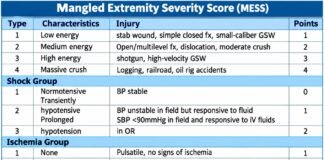
The MUES (Mangled Upper Extremity Score) is a simple scoring system used by surgeons to assess how severe a badly injured upper limb is and to help decide whether the limb can be saved. It was developed because lower-limb injury scores, such as MESS, do not work well for upper-limb injuries.
A “mangled upper extremity” in the study means injury to at least three tissue components—for example skin/soft tissue, bone, muscle/tendon, nerve, or blood vessels—proximal to the digits. The score is meant for early emergency-department assessment, not as a replacement for surgical judgment.
How to calculate it
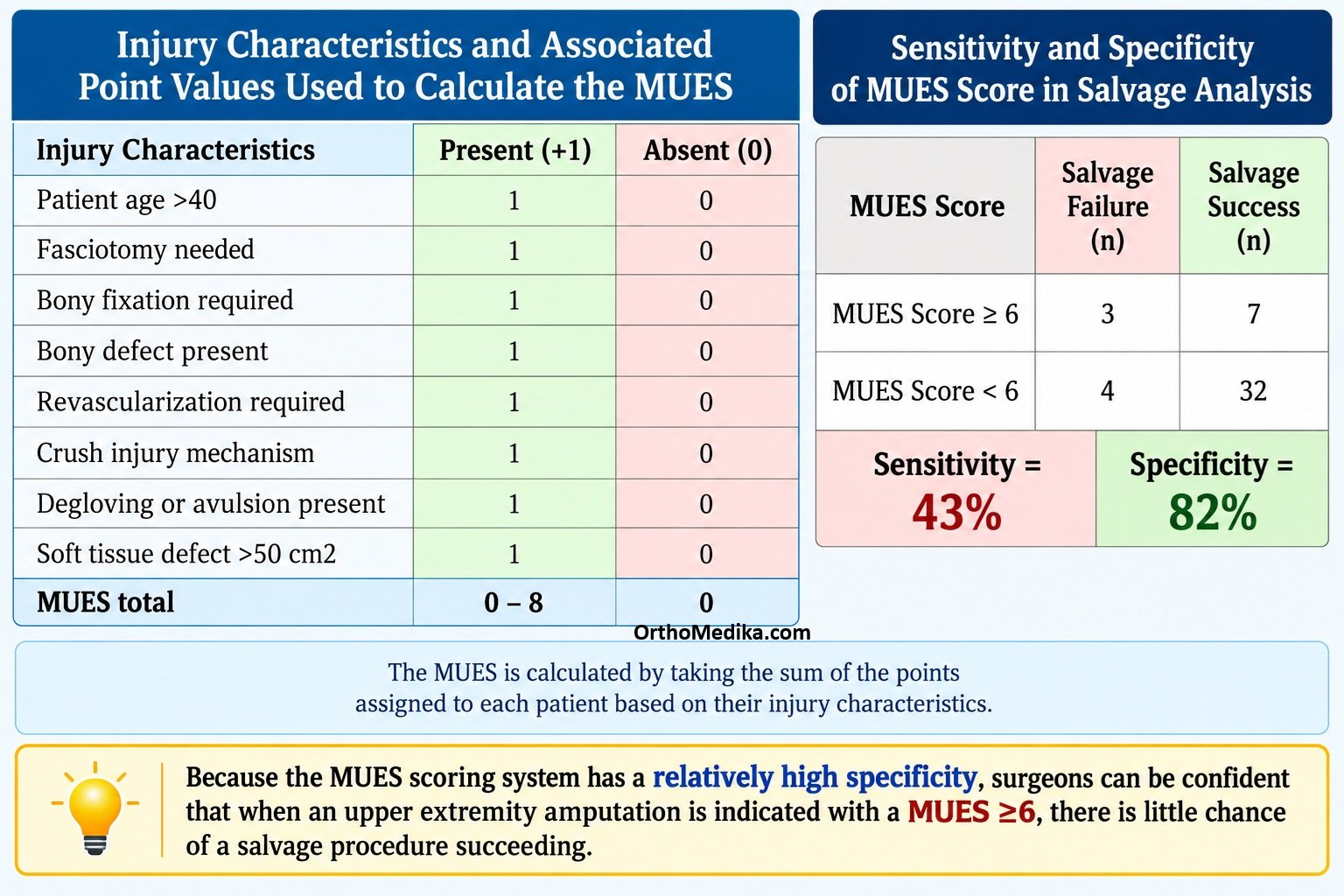
Assign 1 point for each feature present; add the points. Maximum score = 8.
| Feature | Points |
| Age > 40 years | 1 |
| Fasciotomy needed | 1 |
| Bony fixation required | 1 |
| Bony defect present (study specifies ≥2 cm) | 1 |
| Revascularization required | 1 |
| Crush injury mechanism | 1 |
| Degloving or avulsion injury | 1 |
| Soft-tissue defect > 50 cm² | 1 |
Example: A 34-year-old with a crush/avulsion injury requiring fasciotomy, bone fixation, a bony defect, revascularization, and a >50 cm² soft-tissue defect would score 7/8. In the article’s example, that patient ultimately required amputation.
How to interpret the score
- Higher MUES = more severe injury and worse expected outcome. In the study, higher scores correlated with more complications, more operations, and longer hospital stay.pmc.ncbi.nlm.nih
- Score ≥6 was proposed as a threshold suggesting that limb-salvage attempts are unlikely to succeed and early amputation may be more appropriate. At this threshold, MUES had 82% specificity but only 43% sensitivity for identifying futile salvage.
- In practical terms, a score of ≥6 makes failed salvage relatively likely when salvage is attempted—but a lower score does not guarantee successful salvage.
- Mean MUES was 3.89 among successful salvage attempts versus 5.29 among failed salvage attempts.
Why it was developed
The authors found that the commonly used lower-limb MESS did not correlate with complications, number of operations, or hospital stay in upper-extremity injuries. They argued that upper limbs differ anatomically from lower limbs—less muscle mass and different vascular anatomy—so lower-limb scores may not transfer well.
Important limitations
MUES is a decision-support tool, not an automatic amputation rule. It was derived from a single center’s retrospective data, and the authors explicitly recommend that each center calibrate its own salvage threshold based on its reconstructive capabilities. Clinical factors such as warm ischemia time, contamination, patient goals, overall trauma burden, and surgeon expertise remain essential.
What the score means
- MUES below 6: The limb may still be possible to save, but the final decision depends on the patient’s condition and the surgeon’s assessment.
- MUES 6 or more: The injury is very severe. The score has high specificity, so surgeons can be more confident that limb salvage is unlikely to succeed and amputation may be the better choice.
In the study, patients whose limbs were successfully saved had an average MUES of 3.89, while patients who needed amputation after a salvage attempt had an average MUES of 5.29.
Important note
Because MUES has relatively high specificity, a score of 6 or more strongly suggests that an attempted salvage procedure has little chance of success. However, the score is only a guide: surgeons still need to examine the limb, consider the patient’s overall condition, and use their clinical judgment.
REFERENCES:
Savetsky IL, Aschen SZ, Salibian AA, Howard K, Lee ZH, Frangos SG, Thanik VD. A Novel Mangled Upper Extremity Injury Assessment Score. Plast Reconstr Surg Glob Open. 2019 Sep 23;7(9):e2449. doi: 10.1097/GOX.0000000000002449. PMID: 31942406; PMCID: PMC6908405.

 is a simple scoring system used by surgeons to assess how severe a badly injured upper limb)