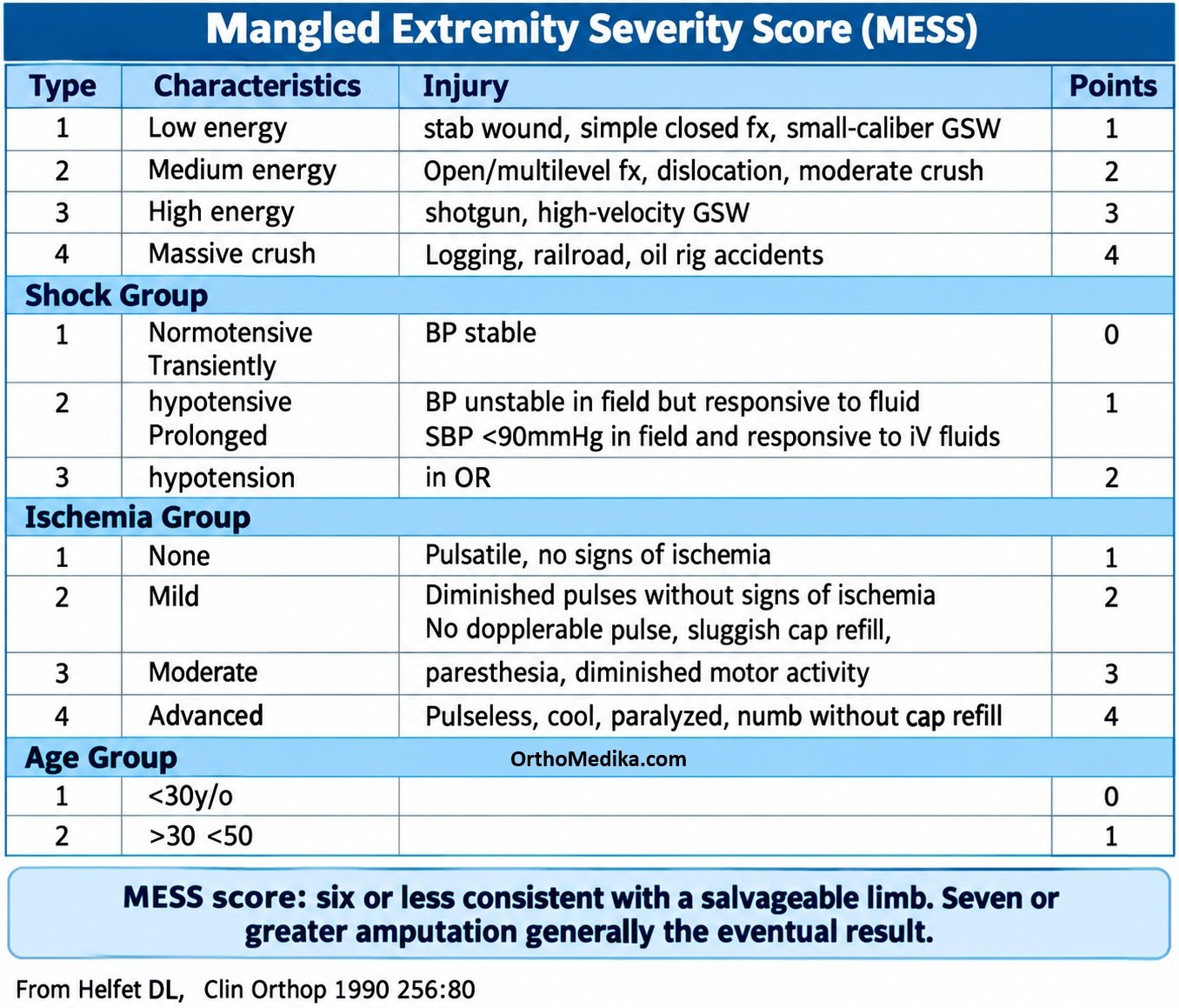
The MESS (Mangled Extremity Severity Score) is a rapid bedside scoring tool for severely injured limbs—especially severe open fractures with vascular compromise—to help estimate the likelihood that amputation will ultimately be needed.
MESS stands for Mangled Extremity Severity Score. It is a quick scoring system doctors use after a very severe leg injury—especially an open fracture with damaged arteries—to estimate whether the leg can be saved or is likely to need amputation. It was developed by Johansen and colleagues in 1990.
The simple idea
Think of MESS as giving “danger points” to an injured leg. The worse the injury, the higher the score.
- Low score: The leg has a better chance of being saved.
- High score: The leg has a higher risk of needing amputation.
- Total score of 7 or more: Traditionally considered very high risk for amputation.
But MESS is only a guide. It does not automatically mean “amputate”; the final decision needs a trauma team, especially vascular, orthopedic, and plastic surgeons.
The four parts of MESS
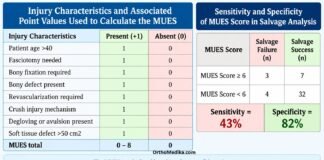
MESS has four parts. You add the points from all four to get the total.
-
Bone and soft-tissue injury
This asks: How badly is the bone, muscle, skin, and tissue damaged?
| Injury type | Points |
| Low-energy injury, such as a simple fall or twisting injury | 1 |
| Medium-energy injury, such as a road accident with fracture | 2 |
| High-energy injury, such as a high-speed crash, crush injury, or fall from height | 3 |
| Very high-energy injury with severe crushing or contamination | 4 |
More points mean more severe tissue destruction.
-
Limb ischemia
“Ischemia” means the leg is not getting enough blood. This is very important because muscles and nerves can die if blood flow is blocked for too long.
| Blood-flow condition | Points |
| Normal pulses and normal blood flow | 0 |
| Weak or absent pulse, but the limb still looks alive | 1–2 |
| No blood flow / pulseless, cold, pale limb | 2–3 |
| If ischemia has lasted more than 6 hours, the ischemia points are doubled | Can become 4–6 |
This is why doctors try to restore blood flow quickly.
-
Shock
Shock means the body is not circulating blood well, often because of major bleeding or severe trauma. Doctors usually assess it using blood pressure and response to fluids.
| Condition | Points |
| Normal blood pressure | 0 |
| Low blood pressure that improves with fluids | 1 |
| Persistent low blood pressure despite fluids | 2 |
Persistent shock makes limb salvage more difficult because the body is prioritizing survival over the injured limb.
-
Age
Older patients generally have poorer tissue healing, more vascular disease, and higher surgical risk.
| Age group | Points |
| Under 30 years | 0 |
| 30–50 years | 1 |
| More than 50 years | 2 |
Example calculation
Imagine a 40-year-old motorcyclist with:
- High-energy open tibial fracture: 3 points
- No pulse in the foot, with ischemia for 7 hours: 2 points doubled = 4 points
- Blood pressure improves after fluids: 1 point
- Age 40: 1 point
Total MESS = 3 + 4 + 1 + 1 = 9
A score of 9 is above the traditional cutoff of 7, so the injury is very severe and amputation risk is high. But it still does not automatically mean the leg must be removed; urgent vascular repair, fracture stabilization, fasciotomy, and soft-tissue reconstruction may still save it.
What the original study found
In Johansen’s original study, limbs that were saved had an average MESS of about 4–5, while limbs that required amputation averaged about 9. In that early study, a MESS of 7 or more predicted amputation with 100% accuracy.
That is why MESS ≥ 7 became a well-known warning threshold.
Why doctors no longer rely on MESS alone
Modern trauma care has improved a lot: faster transport, better vascular repair, external fixation, antibiotics, negative-pressure wound therapy, and free tissue/flap reconstruction. As a result, many patients with MESS ≥ 7 can still keep a useful limb.
In one prospective study of 60 patients with lower-limb vascular trauma, 35 patients had MESS ≥ 7. Despite that, 28 of 35 (80%) had their legs saved after coordinated vascular, orthopedic, and plastic-surgical treatment; only 7 needed later amputation.
Other research also found that MESS has high specificity but low sensitivity—meaning a very high score often indicates severe injury, but a high score does not reliably identify every patient who will need amputation.
REFERENCES:
- Slauterbeck JR, Britton C, Moneim MS, Clevenger FW. Mangled extremity severity score: an accurate guide to treatment of the severely injured upper extremity. J Orthop Trauma. 1994 Aug;8(4):282-5. doi: 10.1097/00005131-199408000-00002. PMID: 7965288.
- Helfet DL, Howey T, Sanders R, Johansen K. Limb salvage versus amputation. Preliminary results of the Mangled Extremity Severity Score. Clin Orthop Relat Res. 1990 Jul;(256):80-6. PMID: 2194732.
- Shalini, A., Singh, D., Dachipalli, S., Maddu, S., & Ram, L. (2020). The Validity of the Mangled Extremity Severity Score Scoring System for Lower Limb Vascular Trauma in a Tertiary Care Center. Indian Journal of Vascular and Endovascular Surgery, 7(2), 141–144. https://doi.org/10.4103/ijves.ijves_63_19

 is a rapid bedside scoring tool for severely injured limbs—especially severe open fractures with vascular compromise)