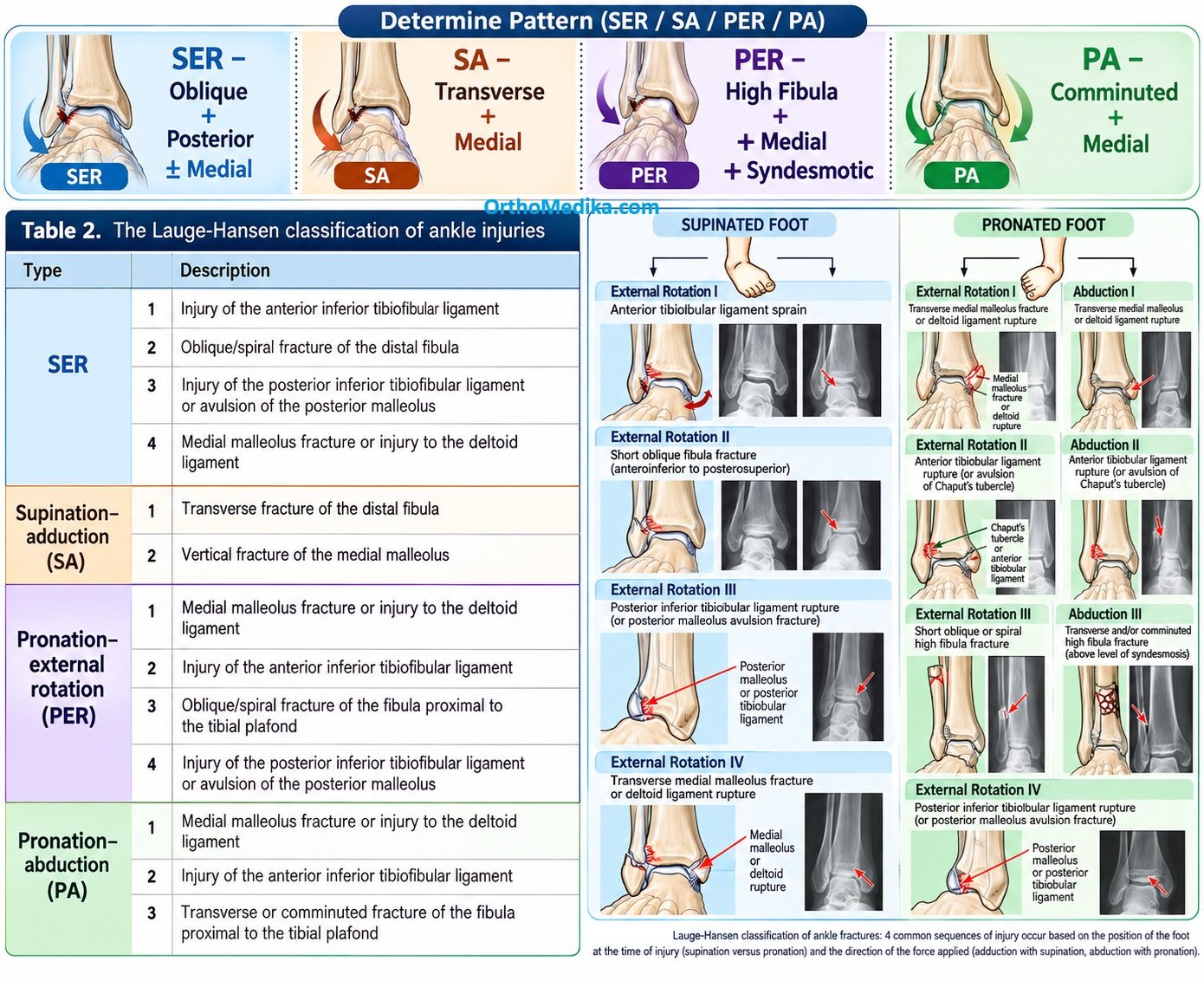
The Lauge-Hansen classification describes ankle fractures by foot position (supination vs pronation) plus deforming force (adduction, external rotation, or abduction). It has 4 types and a predictable cumulative sequence of injuries.
The 4 types Lauge-Hansen Classification
| Type | Full name | Stages | Key pattern |
| SA | Supination-Adduction | I–II | Low transverse fibula, then vertical medial malleolus |
| SER | Supination-External Rotation | I–IV | Most common; low spiral/oblique fibula |
| PER | Pronation-External Rotation | I–IV | Medial injury first, then high spiral fibula |
| PA | Pronation-Abduction | I–III | Medial injury first, then transverse/comminuted fibula |
Supination stresses the lateral side first, while pronation stresses the medial side first.
SA — Supination-Adduction
- SA I: Transverse fracture of the distal fibula, or lateral collateral ligament injury.
- SA II: SA I plus a vertical medial malleolus fracture.
Memory: SA = “Avulsion lateral, vertical medial.”
SER — Supination-External Rotation
Most common type; roughly corresponds to Weber B.
- SER I: AITFL injury / anterior syndesmosis injury
- SER II: Spiral or oblique distal fibula fracture
- SER III: PITFL injury or posterior malleolus fracture
- SER IV: Medial malleolus fracture or deltoid ligament injury.
Memory: SER = A-F-P-M — Anterior, Fibula, Posterior, Medial.
PER — Pronation-External Rotation
- PER I: Medial malleolus fracture or deltoid ligament injury
- PER II: AITFL injury
- PER III: Oblique/spiral fibula fracture above the tibial plafond; may be high, including Maisonneuve-type injury
- PER IV: PITFL injury or posterior malleolus fracturepmc.
- Memory: PER = M-A-F-P — Medial first, then Anterior, Fibula high, Posterior.
PA — Pronation-Abduction
- PA I: Medial malleolus fracture or deltoid ligament injury
- PA II: AITFL injury
- PA III: Transverse or comminuted fibula fracture above the tibial plafond.
Memory: PA = M-P-F — Medial, Posterior/syndesmosis, Fibula comminuted.
Here’s an easy way to memorize the Lauge-Hansen ankle fracture classification: remember “first word = foot position, second word = force direction,” then follow the injury stages in order.
The 4 patterns: S-S-P-P
Use this mnemonic: “Super Students Prefer Pizza”
| Pattern | Foot position | Force | Easy clue |
| SA — Supination-Adduction | Supinated | Adduction (inward) | Low transverse fibula + vertical medial malleolus |
| SER — Supination-External Rotation | Supinated | External rotation | Most common; spiral/oblique fibula at syndesmosis |
| PER — Pronation-External Rotation | Pronated | External rotation | Medial injury first, then high fibula fracture |
| PA — Pronation-Abduction | Pronated | Abduction (outward) | Medial injury first, then comminuted fibula |
The first word tells you whether the foot was supinated (inverted, weight on outer edge) or pronated (everted, weight on inner edge); the second word tells you the deforming force.
Key shortcut: which side injures first?
- Supination → the lateral side is tight/stressed first → lateral fibula injury comes early.
- Pronation → the medial side is tight/stressed first → deltoid ligament or medial malleolus injury comes first.
So:
- S = Start lateral
- P = Start medial
Stage mnemonics
SA: “Low lateral, vertical medial”
- SA1: Transverse fracture of lateral malleolus below syndesmosis, or lateral ligament injury.
- SA2: Add vertical “push-off” fracture of medial malleolus.bofas.org+1
Memory line: Supination-Adduction = “A” for Avulsion lateral, then vertical medial.
SER: “A-F-P-M”
Memorize the sequence as A-F-P-M:
- AITFL / anterior syndesmosis injury
- Fibula: spiral or oblique fracture at syndesmosis level
- Posterior injury: PITFL tear or posterior malleolus fracture
- Medial injury: medial malleolus fracture or deltoid rupture
This is the most common pattern and corresponds roughly to Weber B.
Memory line: SER = “Anterior, Fibula, Posterior, Medial.”
PER: “M-A-F-P”
- Medial injury first: deltoid rupture or transverse medial malleolus fracture
- AITFL / anterior syndesmosis injury
- Fibula fracture above the syndesmosis; can extend high, even to fibular neck (Maisonneuve pattern)
- Posterior injury: PITFL tear or posterior malleolus fracture
This corresponds roughly to Weber C.
Memory line: PER = “Medial first, then Anterior, Fibula high, Posterior.”
PA: “M-P-F”
- Medial injury: deltoid rupture or transverse medial malleolus fracture
- Posterior malleolus fracture or syndesmosal injury
- Fibula: comminuted/transverse fracture above the joint, often with a butterfly fragment
Memory line: PA = “Medial, Posterior, Fibula comminuted.”
One-line exam memory
- SA: low transverse fibula + vertical medial malleolus
- SER: anterior → spiral fibula → posterior → medial
- PER: medial → anterior → high spiral fibula → posterior
- PA: medial → posterior → comminuted fibula
A practical radiograph shortcut: a spiral fibula fracture at the syndesmosis suggests SER, while a high fibula fracture above the syndesmosis suggests PER.
Quick self-test
- Low transverse lateral malleolus + vertical medial malleolus fracture → SA
- Spiral fibula at syndesmosis, posterior and medial injury may follow → SER
- Medial injury first + high fibula fracture → PER
- Medial injury first + comminuted fibula → PA
The classification is hierarchical: once you identify one stage, look for the next predictable injury in that sequence
REFERENCES:
Hermena S, Slane VH. Ankle Fracture. [Updated 2025 Feb 15]. In: StatPearls [Internet]. Treasure Island (FL): StatPearls Publishing; 2025 Jan-. Available from: https://www.ncbi.nlm.nih.gov/sites/books/NBK542324/
Tartaglione JP, Rosenbaum AJ, Abousayed M, DiPreta JA. Classifications in Brief: Lauge-Hansen Classification of Ankle Fractures. Clin Orthop Relat Res. 2015 Oct;473(10):3323-8. doi: 10.1007/s11999-015-4306-x. Epub 2015 Apr 22. PMID: 25900357; PMCID: PMC4562928.
 plus deforming force (adduction, external rotation, or abduction))